

Ⅰ. Where My Questions Began
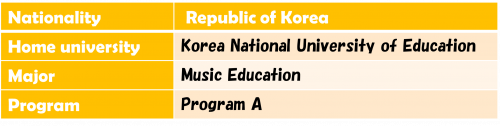
I have always been a teacher who wanted to show my students a wider world. The society they will live in as adults will be far more globalized than it is today, where crossing borders and collaborating across countries will no longer be exceptional. If so, can education that prepares students for such a future remain confined within the standards of a single nation? This question gradually became clearer as I taught in the classroom and pursued my studies in music education in graduate school.
After entering graduate school at Korea National University of Education with the intention of exploring better approaches to education, I was able to encounter a wide range of theories and perspectives that are not easily accessible in everyday school settings. As I engaged with both domestic and international research and case studies in music education, my knowledge certainly expanded. At the same time, however, I began to feel an inexplicable sense of emptiness. Even though I had stepped into a world broader than the classroom, I still felt that there was an even wider world I had yet to understand.
Most of my graduate coursework focused on domestic cases, which allowed me to gain a deep understanding of the structure and characteristics of music education within the context of Korean education. However, living in an era where the world is rapidly becoming interconnected, I began to question whether education can truly be understood within the framework of a single country. Since educational goals, content, and teaching methods can vary depending on social and cultural contexts, I became increasingly curious about how music education is practiced in classrooms in other countries. The more I studied music education, the clearer these questions became, and I came to recognize the limitations of my own perspective, which had been confined within a domestic framework.
At that point, I had no choice but to be honest with myself. I was already a teacher and a graduate student, yet I could not confidently call myself a “globally-minded educator” who could meaningfully discuss education in an increasingly complex world. Simply knowing more was not enough. I felt the need to directly observe, experience, and compare how the same educational ideas are realized differently across societies and cultures.
While continuing my graduate studies with these thoughts in mind, I came across a CAMPUS Asia program announcement in the university library. Before anything else, what caught my attention was its stated goal: “to cultivate educational policy experts who contribute to solving global issues.” The moment I read this, the questions that had been lingering in my mind throughout my graduate studies naturally resurfaced.
CAMPUS Asia did not seem like a program that simply offered opportunities to study abroad. Rather, it felt like a chance to directly observe and examine how the questions I had been asking would take shape in educational settings in other societies. As a teacher and as a graduate student in music education, the concerns I had been carrying began to form a coherent direction through this program.
At that moment, I no longer saw CAMPUS Asia as something to compete for and be selected into, but as a learning opportunity that I genuinely needed at that point in my life. Discovering the program in the library may have been a coincidence, but the decision to apply was closely aligned with the direction in which my questions and reflections had been leading me toward. In this way, CAMPUS Asia was not just one option among many, but the next step toward finding answers to my questions.
II. When Questions Became Experience
The experiences I encountered through the CAMPUS Asia program transformed the questions I had once only contemplated through books and lectures into concrete images of real educational settings. Observing and experiencing how education is implemented in different social and cultural contexts allowed me to move beyond abstract comparisons and instead reflect on my own assumptions and standards. The following scenes represent moments when my questions and reflections took shape as lived experiences, ultimately leading to a meaningful shift in how I view education.
1. Different Schools, One Educational Philosophy: IB Education in Japan
The first school I visited in Japan was Sakado High School in Saitama Prefecture. Although it is a public high school, it was implementing the IB (International Baccalaureate) curriculum. IB is an international educational framework that emphasizes inquiry, critical thinking, and communication rather than the simple transmission of knowledge. For someone like me, who had believed that public schools in Korea are bound by fixed curricula and face significant constraints when introducing new programs, the fact that a public high school was actively operating such a curriculum came as a shock. At that moment, my long-held assumption that “public education is difficult to change” began to break down.
Through explanations from a teacher at Sakado High School, I came to understand the educational concerns that had led to the development of the IB curriculum, as well as the kinds of subjects and learning activities students engage in. What impressed me even more, however, was observing the actual classes. The students participating in IB lessons were not a select group of elite learners, but ordinary public school students one might encounter anywhere. Contrary to my preconceived notion that IB was designed only for high-achieving students, I saw that students in this setting were developing communication skills essential for the future while engaging in learning experiences that extended beyond the traditional classroom. This led me to reconsider whether educational change is determined not by the “level” of students, but by the “philosophy” that education is built upon.
The next school I visited, Tsukuba International School (TIS), was not a public school, but it offered a clearer picture of how IB philosophy can be fully realized across an entire school. Both students and teachers came from diverse national backgrounds, and the curriculum was not structured around conventional subject divisions, but rather designed to cultivate competencies that students genuinely need. From classrooms to hallways and learning spaces, the physical environment of the school was also intentionally designed to support natural inquiry and interaction among students, which left a strong impression on me.
Although Sakado High School and Tsukuba International School differed in their institutional structures and modes of operation, they shared a common foundation in the IB philosophy, which was implemented in distinct ways within different systems. Through these two schools, I came to realize firsthand that the form education takes is not fixed by systems alone, but can vary significantly depending on the philosophy that guides it. It was a moment when I recognized that the educational practices I had long taken for granted were not the only possible answer, and it offered me an important starting point for reconsidering how I should approach and design education as a teacher.
2. A Different Way of Teaching Music
While visiting another school, Kasuga Compulsory Education School, I was able to more clearly recognize the differences in music education within my own field of specialization. Kasuga is a public school in Japan that integrates elementary and lower secondary education into a single system, designed to provide students with a more continuous and coherent learning experience. What struck me first was the environment of the music classroom. The spacious room and the natural arrangement of a wide variety of instruments gave me the impression that the space itself had been intentionally designed to allow students to engage with music as a part of their everyday lives.
This approach was also reflected in the structure of the textbooks. In Japan, there are not only general “Music” textbooks, but also separate textbooks dedicated to instruments. I was told that first-year middle school students learn the alto recorder, which led me to realize a clear difference in both the scope and depth of music education, especially considering that many students in Korea have little to no experience with the alto recorder.
Such an educational approach was even more evident in the students’ musical abilities. One of the project-based lessons introduced by the music teacher involved students composing and writing lyrics for their own class song. The completed pieces were of such high quality that it was hard to believe they had been created by middle school students. Although teacher guidance and support were certainly involved, what stood out to me was that students were not treating music merely as something to learn, but as a language through which they could express themselves.
Through this experience, I was once again reminded that music education gains greater meaning when it moves beyond theoretical understanding and becomes closely connected to students’ lives. While it may be difficult to directly apply the Japanese approach to Korea, I felt that there is significant value in creating opportunities for students to engage with music more frequently and more deeply. This experience ultimately broadened the criteria by which I understand and evaluate music education.
3. Beyond Language: Communication Through Attitude
In both classroom-based learning and field visits to actual educational settings, I worked in teams composed of members from diverse national backgrounds. Communication among team members with different linguistic and cultural backgrounds inevitably took place primarily in English, and naturally, the ways and pace at which individuals participated in conversations varied. Some expressed their ideas actively, while others responded briefly to questions or appeared cautious in continuing conversations.
At first, I interpreted these differences as a matter of individual personality or willingness to participate. This judgment reflected my own perspective, shaped in contexts where being less talkative in group situations is often quickly associated with having a passive personality. However, as I continued to engage in multiple team activities and conversations, I gradually came to understand that much of this silence did not stem from a lack of initiative, but from the burden of having to communicate in English. In unfamiliar linguistic and cultural environments, hesitation in speaking is, in fact, a natural response.
I could not say that I was particularly proficient in English either. Nevertheless, I made an effort to express my thoughts, even when my sentences were not perfect. Through repeated experiences, I found that these small attempts often became the starting point of meaningful conversations. What I came to realize through this process was that the most important element in communication is not accuracy or fluency, but the attitude of trying to understand others and the patience to give them time.
This experience made it clear that the CAMPUS Asia program is not simply about providing an international environment, but about creating a space where individuals from different linguistic and cultural backgrounds can learn how to build relationships and collaborate in real situations. Even when expression was imperfect, it was still possible to understand one another and sustain meaningful communication, and I came to deeply recognize that this capacity is grounded not in language proficiency, but in attitude.
III. Beyond a Teacher in Korea: Becoming an Interpreter of Education
Through the CAMPUS Asia program, I was able to directly experience diverse educational settings beyond the classroom and encounter a broader world of education. Previously, I had understood the role of a teacher as faithfully implementing the Korean national curriculum within the classroom. However, through this program, I came to realize that teachers of the future must be able to interpret and reconstruct education within an international context. Only then can we provide truly meaningful education for students who will live in an increasingly complex global society. This experience showed me that international exchange is not merely an expansion of experience for teachers, but a powerful tool for rethinking and redesigning education itself.
Now that I have completed the CAMPUS Asia program, I no longer define myself solely as “a teacher in Korea.” Rather than remaining within the boundaries of implementing a given curriculum, I have developed the perspective to observe and interpret education beyond the classroom. I am no longer focused only on meeting prescribed achievement standards; instead, I am becoming a teacher who reflects on what competencies students will need in the future and seeks to design educational directions accordingly within a global context.
This transformation was not limited to a shift in perspective. By directly experiencing diverse educational environments around the world, I came to understand more concretely that education cannot be discussed solely within the framework of a single nation, but is closely intertwined with social, cultural, and policy contexts. Reflecting on how global issues are interconnected and how education can contribute to addressing them naturally led me to reconsider my role as a teacher.
As a result, I began to approach my graduate research from a broader perspective than before. I am currently preparing my master’s thesis titled “A Comparative Study on the Structure of the Listening Domain in Elementary Music Textbooks in Korea and Japan,” examining music education not only within a national framework but also from comparative and policy-oriented perspectives. Furthermore, I am seriously considering pursuing a doctoral degree at the University of Tsukuba, where I experienced academic exchange through this program. This demonstrates that CAMPUS Asia has enabled me to grow beyond being a participant in an overseas program into a researcher who engages with both educational policy and classroom practice.
CAMPUS Asia was not simply a program that provided opportunities to study abroad and visit educational institutions. It allowed me to reexamine where I stand as a teacher and to develop the ability to interpret education beyond national boundaries. My transformation reflects one example of the kind of individual that CAMPUS Asia aims to cultivate. It is not a program that produces teachers with overseas experience, but one that brings future educators into the present.