

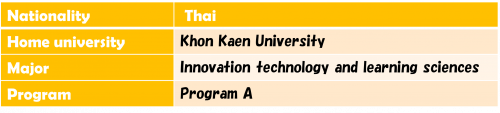
[1]. Introduction and Motivation As a Master’s degree student from Khon Kaen University specializing in education, my motivation for joining the Campus Asia 6 program at the University of Tsukuba was driven by a specific curiosity: I wanted to understand the “system” behind Japan’s educational success. While Thailand shares similar educational structures—such as the 9-year compulsory education system—the management and outcomes often differ. I was particularly interested in how Japan implements Inquiry-Based Learning to address complex global issues like Climate Change. My goal was not merely to observe teaching techniques, but to uncover the underlying mechanisms that connect national policy, scientific research, and classroom practice.
[2]. The Core Insight: An Educational Ecosystem Over the course of three months, I conducted fieldwork at eight distinct locations ranging from local schools to national research institutes. My most significant realization was that effective education in Japan does not rely solely on the efforts of individual teachers. Instead, it functions as a collaborative ecosystem driven by three key gears: Policymakers, Researchers/Scientists, and Educators.
[3]. The Foundation: Policy and Readiness My visits to the National Institute for Educational Policy Research (NIER) and the Tsukuba City Board of Education revealed a balance between national direction and local autonomy. While the central government sets the strategic standards, local boards have the freedom to craft their own identity. Tsukuba, as a “Science City,” utilizes this autonomy to integrate science deeply into its curriculum, creating a unique local identity that serves community needs.
This policy is supported by immense “readiness,” which I witnessed at Kasuga Gakuen School. Structurally, this compulsory school resembles Thailand’s “Opportunity Expansion Schools.” However, the management approach is distinct. The availability of modern facilities, fully equipped teaching materials, and, crucially, a dedicated team of support staff allows teachers to focus primarily on instruction rather than administrative burdens. This structural readiness is the foundation that makes inquiry-based learning practically possible.
[4]. The Driver: Science in Daily Life A pivotal moment in my learning journey occurred at the Meteorological Research Institute (MRI), the National Institute of Advanced Industrial Science and Technology (AIST), and the Tsukuba Botanical Garden. I observed that these institutes are not isolated ivory towers but function as accessible learning hubs for the community.
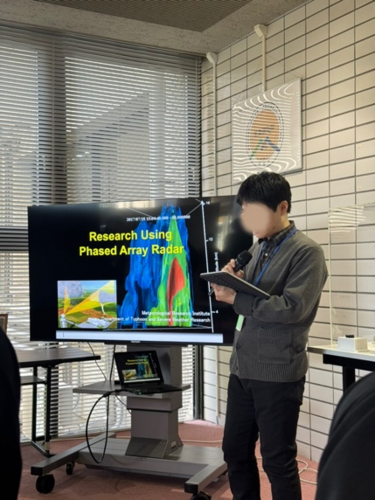
At the MRI, I saw how researchers actively communicate complex climate change data to the public, transforming high-level science into daily relevance. This experience highlighted that in a developed nation, researchers act as vital “gears” that drive society. They do not work in isolation; they collaborate with policymakers to shape national development and provide the evidence base necessary for sound education. This synergy ensures that the youth are cultivated through a system rooted in scientific fact and awareness of their environment.
[5]. The Classroom: Inquiry in Action I witnessed the practical application of these concepts at Senior High School at Sakado, Tsukuba International School, and Fujishiro High School. At Sakado, the International Baccalaureate (IB) framework fosters critical thinking on global scales.
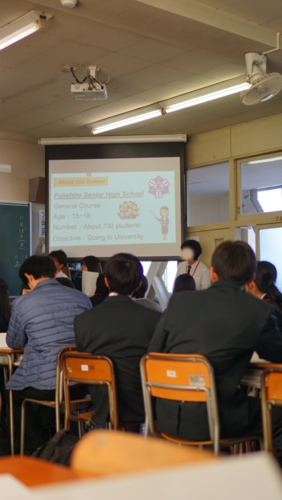
A particularly striking example was at Fujishiro High School, a public institution, where I observed students discussing “Plastic Waste Reduction” during an English class. This demonstrated that inquiry-based learning in Japan is cross-disciplinary. It uses language not just as a subject of study, but as a tool to cultivate environmental awareness and problem-solving skills. It proved that when students are engaged in relevant, real-world topics, they develop a deeper sense of global citizenship.
[6]. Quality Assurance: Teachers as Researchers The sustainability of this ecosystem relies on the quality of educators. Attending the Society of Japan Science Teaching (SJST) conference at Saitama University showed me that Japanese teachers view themselves as “researchers.” They do not stop learning after graduation; instead, they actively conduct research on their own classrooms and share findings with peers. This professional culture of continuous improvement ensures that the educational system constantly evolves to meet new challenges.
[7]. Cultural Harmony: The Music Night Finally, the Campus Asia 6 Music Night highlighted the importance of cultural diplomacy. Representing Thailand, I performed the Thai Ramwong, joined by friends from Korea, China, Japan, and Indonesia. This activity reinforced the concept of “Unity in Diversity.” It was a powerful reminder that while systems and policies are important, the human connection is equally vital. Just as different musical instruments create a harmony, different nations can collaborate to solve global problems. It taught me that open-mindedness and cultural respect are essential soft skills for working in a global context.
[8]. Conclusion The Campus Asia 6 program has transformed my perspective from viewing education as a classroom activity to seeing it as a societal ecosystem. I have learned that for inquiry-based climate change education to succeed in Thailand, we cannot rely on teachers alone. We must foster collaboration where policymakers provide the support, scientists provide the evidence, and educators guide the inquiry. I am committed to taking this “Ecosystem Mindset” back to Khon Kaen University to contribute to the development of sustainable education in my home country.
An official from the Meteorological Research Institute (MRI) lecturing on weather forecasting research using new technologies.
The classroom atmosphere at Fujishiro High School during an English lesson where students engaged in a discussion about plastic waste issues.