

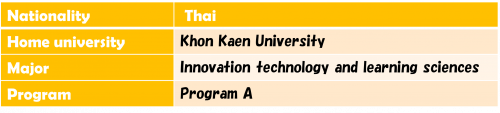
I returned to my home country with everything except my heart. The professors, faculty members, CA6 coordinators, and fellow participants left me with memories that I will always treasure. The CA6 Program at the University of Tsukuba was not simply an academic experience; it was a life-changing journey that shaped my perspective, strengthened my professional vision, and connected me to people from around the world.
I was motivated to join the CA6 Program even before I officially entered my master’s program. I had been waiting for the right opportunity, and when the application finally opened, I did not hesitate to apply. Being selected as a participant at the University of Tsukuba was truly meaningful to me. Another strong motivation was my curiosity about Japan’s education system particularly how Sustainable Development Goals (SDGs) are integrated into educational practices. I wanted to understand why SDGs are considered so important in Japanese education and how they are implemented in real classrooms. The CA6 Program offered the perfect opportunity to explore these questions in depth.
During the three months at the University of Tsukuba, it is difficult to choose just one memorable experience because I cherish every single moment. One of the most impressive aspects of the program was the dedication of the coordinators. They worked tirelessly to organize academic and cultural activities and took exceptional care of all participants. Their professionalism and commitment deeply touched me, and I consider them role models for my own professional development. The mentoring system was another highlight. Each participant was assigned a mentor and a tutor. I am sincerely grateful to my mentor for encouragement and academic guidance throughout the program. I was also very close to my tutor, who helped me settle into life in Japan, supported me both academically and personally, and made me feel truly welcome.
The CA6 Program was structured into three stages. In Stage 1, we completed online coursework. In Stage 2, we gained deeper insights into the Japanese education system, the International Baccalaureate (IB) program, SDGs, and problem-solving seminars. I would like to express my appreciation to all the professors who created an inclusive learning environment where students from diverse backgrounds could exchange perspectives and learn from one another. Beyond classroom learning, we participated in valuable fieldwork at various institutions, including elementary schools, junior high schools, international schools, and governmental organizations such as MEXT and NIER. One of the most inspiring experiences was observing and participating in an English Communication class at Fujishiro High School. We explored the topic “What can we do to reduce plastic waste at school?” through debates and collaborative problem-solving activities with students. This experience helped me realize that global issues should not be limited to science subjects; they can be meaningfully integrated into language classrooms as well. I was fascinated by how the teacher incorporated real-life global issues into an English lesson by making learning relevant, engaging, and meaningful. I observed students actively developing problem-solving, communication, leadership, and collaboration skills. This experience inspired me to integrate global issues into my own teaching practice in the future.
In addition, the SEM Student Exchange Meeting allowed us to share our learning with other students in the program. I was impressed by the student-led nature of this event, where participants worked in groups, assigned roles, and practiced presentation skills. This is an activity I hope to adapt and implement in my own educational context.
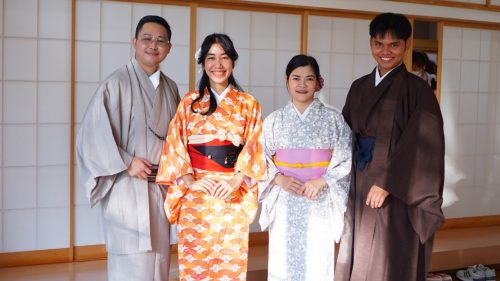
The CA6 Program also offered rich cultural experiences, such as tea ceremonies, kimono try-ons, and music nights. These activities deepened my understanding of Japanese culture and allowed me to learn through joyful and meaningful experiences. I truly enjoyed every moment. In Stage 3, which will take place in March, we will participate in an online international conference to present the research we conducted during Stages 1 and 2. I am very much looking forward to sharing my work and learning from other participants.
One of the most valuable aspects of the CA6 Program was the opportunity to study in an international environment. I built strong relationships with professors, coordinators, staff members, and fellow CA6 participants. Through discussions and collaborations with people from different cultural and academic backgrounds, my perspective was greatly broadened. These friendships are something I will cherish forever. Everyone was open-minded and inspiring.
This program has given me clear direction for my future research and career. I aim to apply the educational approaches I observed particularly the integration of SDGs, problem-based learning, and student-centered activities into my own teaching and research. I hope to contribute to education that is meaningful, globally aware, and responsive to real-world challenges.
The CA6 Program left me with beautiful memories of Japan and helped me grow both personally and professionally. It encouraged me to strive to become a better educator and researcher. CA 6 is more than an exchange program. It is a bridge to connect people, ideas, and cultures, allowing us to learn from one another.
I will carry this experience with me always.
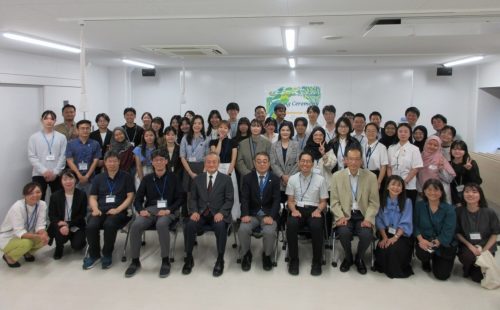
The beginning of our CA6 journey
The Thai team at the Kimono Try-On Event, experiencing the elegance and beauty of traditional Japanese attire.